

Is Your Property Performing as Well as It Should?
Before improving performance, you first need to understand where your rental property stands today.
Many landlords evaluate success using only one metric: whether rent is being paid. While rent collection is important, it provides only a partial picture of property performance.
A more useful starting point is calculating rental yield and benchmarking your property against comparable rentals in your area.
Gross Rental Yield
Gross rental yield measures annual rental income as a percentage of property value.
Formula:
Gross Rental Yield (%) = Annual Rental Income ÷ Property Value × 100
For example, if a property worth UGX 400 million generates UGX 30 million annually in rent, the gross yield is 7.5%.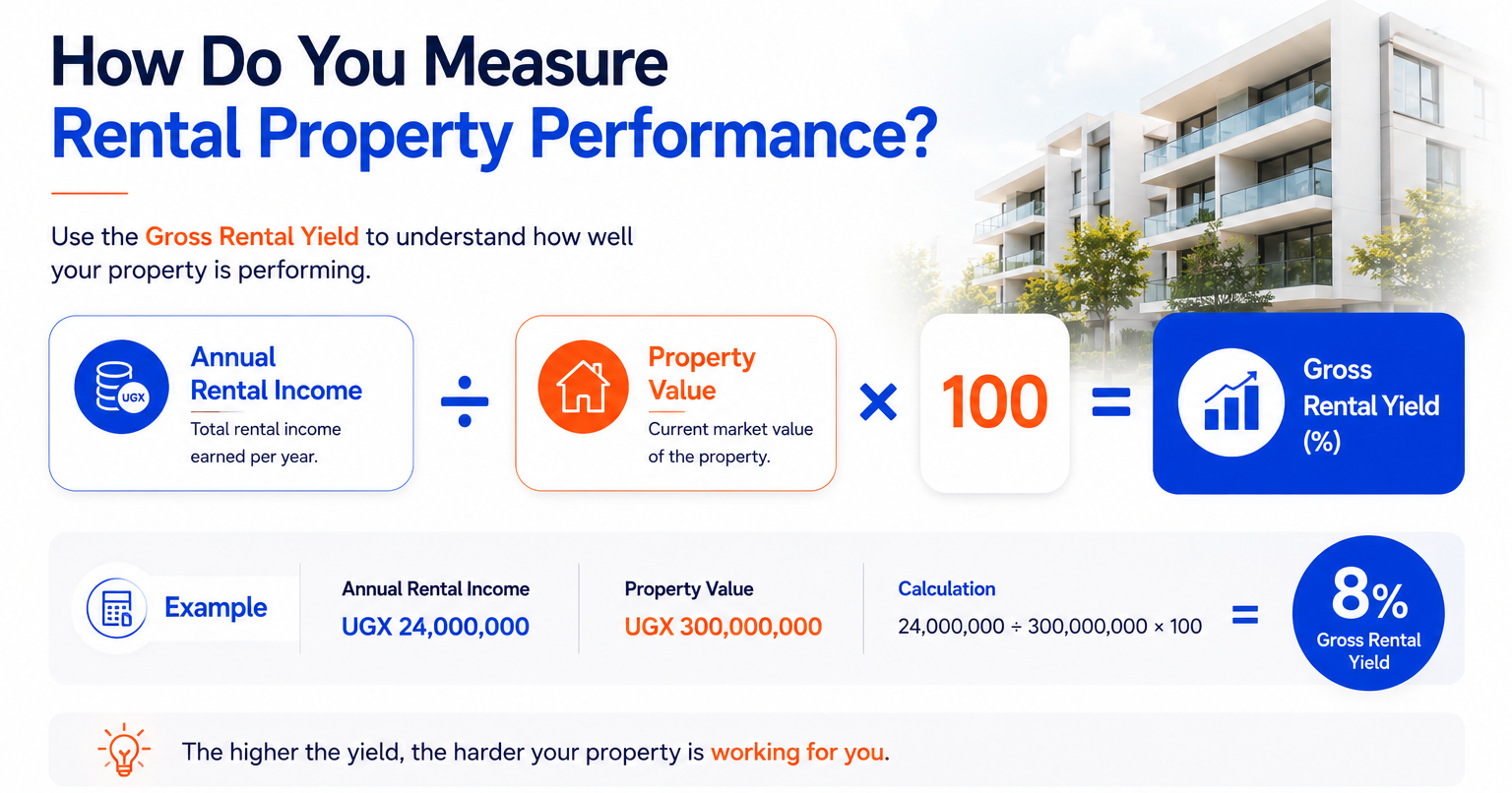
Signs Your Property Is Underperforming
Many landlords discover problems only after income begins declining. Common warning signs include:
- Units remaining vacant for more than six weeks
- Frequent tenant turnover
- Rent levels below comparable properties
- Maintenance issues accumulating over time
- Expired tenancy agreements
- Poor rent collection consistency
One of the biggest causes of underperformance is incorrect pricing. Some landlords unknowingly leave money on the table by charging below-market rent, while others price too aggressively and create costly vacancies. Understanding where your property sits within the local market is essential. Our guide on how to price your rental property correctly in Kampala explores the full benchmarking framework and common pricing mistakes landlords make.
Tenant Acquisition: Finding the Right People, Not Just Any People
Poor tenant selection is often the most expensive mistake a landlord makes.
Many property owners become so focused on filling a vacancy that they overlook the long-term consequences of placing the wrong tenant. Late payments, property damage, disputes, and eviction costs can easily exceed several months of lost rent.
A structured screening process helps reduce these risks before they become expensive problems.
Professional screening typically includes:
- Identity verification
- Employment verification
- Income assessment
- Previous landlord references
- Character references
- Household composition review
Landlords who skip these steps often learn the hard way that a vacant unit is not necessarily the biggest risk. In fact, as we discuss in our guide on how to screen tenants effectively, thorough screening is one of the most powerful tools available to protect rental income and preserve property value.
Legal Compliance: The Area Most Landlords Ignore
Legal exposure remains one of the most overlooked risks in Kampala’s rental market.
Many landlords continue operating with verbal agreements, expired leases, or generic contracts downloaded from the internet. Unfortunately, these arrangements often create problems when disputes arise.
Every tenancy should be supported by a properly drafted agreement that clearly defines:
- Rent obligations
- Maintenance responsibilities
- Notice periods
- Renewal terms
- Grounds for termination
Documentation becomes particularly important if a dispute reaches the Landlord and Tenant Tribunal.
Landlords looking to strengthen their documentation should start with our tenancy agreement checklist for residential apartments in Kampala, which outlines the key clauses every residential lease should contain.
Many disputes can also be traced back to a handful of recurring mistakes. Our article on five legal mistakes Kampala landlords make will explore these risks in greater detail and explains how to avoid them.
Managing Rent Collection and Arrears
Consistent rent collection is the heartbeat of a profitable rental investment.
The most successful landlords treat rent collection as a system rather than a monthly negotiation.
A clear payment structure, documented due dates, written reminders, and consistent enforcement all contribute to healthier cash flow.
What many landlords fail to realize is that rent collection becomes significantly easier when tenants are happy and choose to stay longer. High tenant turnover often creates more financial instability than moderate rent adjustments. That’s why we encourage landlords to understand why tenant retention matters more than rent increases, particularly in competitive residential markets.
When Professional Management Makes Financial Sense
Property management fees are often viewed as an expense.
The better question is whether self-management is costing more.
Many landlords underestimate the hidden costs of handling everything themselves:
- Time spent chasing rent
- Emergency maintenance calls
- Vacancy management
- Legal disputes
- Tenant screening
- Contractor coordination
The true financial impact is often larger than expected.
Our analysis of the real cost of poor property management shows how operational inefficiencies quietly reduce rental returns over time. Landlords who are considering outsourcing should also compare DIY vs professional property management in Kampala to understand when professional support begins generating a positive return on investment.
For landlords evaluating service providers, our guide on what to look for when hiring a property manager in Uganda provides a practical framework for making the right decision.
Pricing Your Rental Correctly
Pricing is one of the most important decisions a landlord makes, yet it is often based on guesswork rather than market evidence.
Some landlords underprice their units because they fear vacancy. Others overprice because they believe their property’s value should automatically translate into higher rent. Both approaches can reduce long-term profitability.
The most effective pricing strategy begins with understanding the market. Compare your property against similar units in the same neighborhood, taking into account factors such as location, size, amenities, security, parking availability, and overall condition. A two-bedroom apartment in Ntinda may command a very different rent from a similar unit in Kisaasi or Najjera, even when the floor plan is nearly identical.
Landlords should also understand the true cost of vacancy. While a vacant unit generates no income, accepting significantly below-market rent can result in thousands of shillings in lost revenue every month. The goal is to find the balance between occupancy and profitability.
Rent increases should also be approached strategically. Sudden or excessive increases often encourage good tenants to leave, creating turnover costs that outweigh the additional rent collected. Transparent communication, proper notice, and timing adjustments around lease renewal periods usually produce better outcomes.
Property type also affects pricing. Furnished units often attract different tenant profiles and may justify higher monthly rents, while unfurnished properties tend to attract longer-term occupants seeking stability.
Landlords who want a deeper understanding of market comparisons, pricing psychology, and yield optimization should explore our detailed guide on how to price your rental property correctly in Kampala.
Legal Compliance: The Area Most Landlords Ignore
Legal compliance rarely feels urgent until something goes wrong.
Unfortunately, many landlords only discover weaknesses in their documentation when disputes arise, tenants stop paying rent, or eviction becomes necessary.
One of the most common issues in Kampala’s rental market is the use of verbal agreements or outdated tenancy documents. While these arrangements may appear convenient, they often create uncertainty regarding rent obligations, maintenance responsibilities, notice periods, and dispute resolution.
A properly drafted tenancy agreement should clearly define:
- Rental amount and payment schedule
- Security deposit terms
- Maintenance responsibilities
- Occupancy rules
- Lease duration
- Renewal procedures
- Termination conditions
Good documentation protects both landlords and tenants.
Landlords must also understand their legal obligations regarding habitability, repairs, and property maintenance. Neglecting these responsibilities can create disputes and expose property owners to unnecessary risk.
In situations where disagreements escalate, documentation becomes critical. Cases brought before the Landlord and Tenant Tribunal are often decided based on the quality and completeness of records rather than verbal claims.
Some of the most common legal mistakes landlords make include:
- Operating without signed tenancy agreements
- Failing to issue proper notices
- Inadequate record keeping
- Poor documentation of maintenance requests
- Unclear deposit handling procedures
If you are unsure whether your current documentation meets best practice standards, our tenancy agreement checklist for residential apartments in Kampala provides an excellent starting point.
Managing Rent Collection and Arrears
Consistent rent collection is the heartbeat of a profitable rental property.
Without predictable cash flow, even a well-located property can quickly become a financial burden.
The most successful landlords establish clear payment systems from the beginning of the tenancy. Rent due dates, acceptable payment methods, late payment consequences, and communication procedures should all be documented before occupancy begins.
In Kampala, mobile money and bank transfers remain the most common payment channels. Both can work effectively provided that transactions are documented and reconciled consistently.
The real challenge often emerges when tenants fall behind.
Many landlords make the mistake of handling late payments informally, hoping the situation will resolve itself. Unfortunately, delayed intervention frequently leads to larger arrears and more difficult recovery processes.
A structured escalation process should typically include:
- Friendly reminder
- Written follow-up
- Formal demand notice
- Legal notice where necessary
Consistency is essential. Policies that are applied selectively often create confusion and weaken the landlord’s position.
At the same time, rent collection should never be viewed in isolation. Stable, satisfied tenants are generally more reliable payers than tenants who feel neglected or undervalued. This is one reason why many experienced landlords prioritize tenant retention over aggressive rent increases. As discussed in our article on why tenant retention matters more than rent increases, long-term occupancy often creates stronger financial outcomes than short-term rent maximization.
Where arrears become persistent or complex, engaging a professional property manager or legal advisor may help resolve issues more efficiently while protecting landlord interests.
Maintenance: What You Must Do vs What You Can Defer
Maintenance is one of the easiest areas to postpone and one of the most expensive areas to neglect.
Many landlords focus on visible repairs while overlooking the cumulative impact of smaller maintenance issues. Over time, these minor problems affect tenant satisfaction, property value, and occupancy levels.
Certain maintenance responsibilities are non-negotiable. Landlords are generally expected to maintain safe and habitable living conditions, including structural integrity, plumbing systems, electrical installations, and essential building functions.
A practical maintenance system does not need to be complicated.
Even individual landlords can benefit from:
- A dedicated maintenance reporting process
- A contractor contact database
- Inspection schedules
- Maintenance tracking records
One of the most effective strategies is adopting preventive maintenance rather than relying solely on reactive repairs.
Preventive maintenance may include:
- Quarterly inspections
- Plumbing checks
- Roof inspections
- Electrical assessments
- Exterior repainting schedules
These activities often cost significantly less than emergency repairs resulting from deferred maintenance.
More importantly, well-maintained properties attract better tenants, support stronger rental rates, and improve tenant retention.
When Professional Management Makes Financial Sense
Not every landlord needs a property manager.
However, every landlord should understand the true cost of self-management before deciding to manage independently.
Many property owners evaluate management fees as a direct expense while overlooking the hidden costs associated with managing rental property themselves.
These costs often include:
- Vacancy losses
- Poor tenant selection
- Rent collection delays
- Legal disputes
- Maintenance coordination
- Contractor management
- Time spent responding to tenant issues
For landlords with demanding careers, multiple properties, or limited availability, these hidden costs can easily exceed professional management fees.
Professional management often becomes increasingly valuable when:
- A landlord owns multiple units
- Properties are located far from the owner
- Occupancy levels require active oversight
- Tenant turnover is increasing
- Compliance and documentation become difficult to maintain
The key question is not whether management costs money.
The better question is whether professional management increases net returns after accounting for time savings, risk reduction, improved occupancy, and stronger operational performance.
Conclusion: Building Wealth Through Better Property Management
Successful landlords understand that rental property is not simply about collecting rent. It is about managing an income-generating asset with deliberate systems and informed decision-making.
The difference between a property that struggles and a property that consistently builds wealth often comes down to a handful of fundamentals:
- Correct pricing
- Effective tenant screening
- Strong legal documentation
- Consistent rent collection
- Proactive maintenance
- Professional oversight where appropriate
Most landlords are already doing some of these things well.
The challenge is that even one weak area can quietly reduce profitability, increase risk, and limit long-term growth.
Whether you own a single rental unit or an expanding portfolio, improving these systems can significantly enhance both income and asset value over time.
Book a Free Property Assessment
If you would like an objective review of your property’s current performance, Rizton Properties can help.
Our team will assess your property’s rental position, benchmark your pricing against the market, identify performance gaps, and provide practical recommendations to improve profitability.